Dental Implants in San Francisco, CA
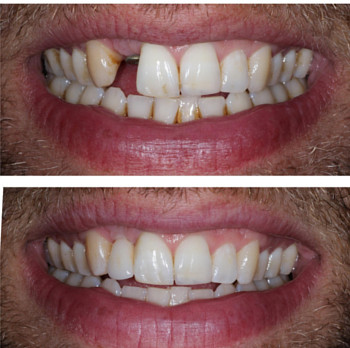
People are living longer than ever, and while regular brushing, flossing, and checkups allow many of us to maintain our natural smiles for a lifetime, sometimes our teeth just can’t keep up. If you’ve lost a tooth (or a few teeth) due to injury or disease, dental implants can rejuvenate both your smile and your oral health.
At Union Square Dental Practice, dental implants are used to restore missing teeth with stable, natural-looking replacements designed to support chewing function, smile aesthetics, and long-term oral health.

What Are Dental Implants?
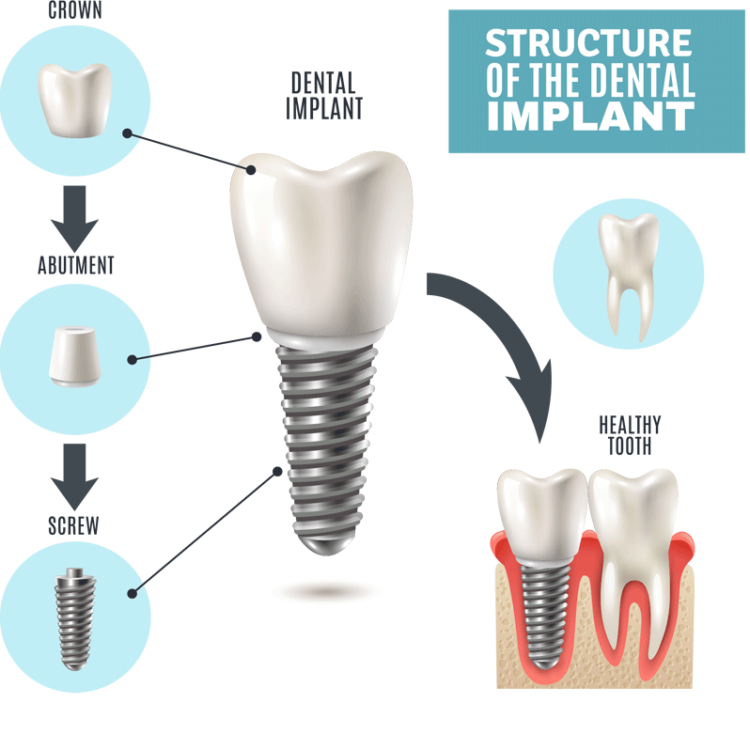
An implant is a synthetic tooth root in the shape of a post that is surgically placed into the jawbone. The “root” is usually made of titanium: the same material used in many replacement hips and knees, and a metal that is well-suited to pairing with human bone. A replacement tooth is then fixed to the post. The tooth can be either permanently attached or removable. Permanent teeth are more stable and feel more like natural teeth.
Dental implants are often used to replace one missing tooth, several missing teeth, or a full arch of teeth. Because implants integrate with the jawbone, they provide a stable foundation for crowns, bridges, or implant-supported dentures.
Benefits of Dental Implants
- Replaces missing teeth with stable restorations
- Helps preserve jawbone structure
- Restores chewing function
- Supports natural-looking smile aesthetics
- Does not rely on neighboring teeth for support
- Can replace one tooth, multiple teeth, or a full arch
- Helps improve confidence when eating and smiling
- Designed for long-term function with proper care
Single or Multiple Implants
Dental implants are versatile. If you are only missing one tooth, one implant plus one replacement tooth will do the trick. If you are missing several teeth in a row, a few strategically placed implants can support a permanent bridge (a set of replacement teeth). Similarly, if you have lost all of your teeth, a full bridge or full denture can be permanently fixed in your mouth with a strategic number of implants.
Advantages Over Dentures or Bridges
Conventional bridges and dentures are not fixed to the bone, and can therefore be unstable. This can make it difficult to eat or smile with confidence. Implants not only look more natural, but feel and act more like normal teeth, with a stronger biting force. And because they don’t directly rely on neighboring teeth for support, implants don’t compromise the health of your natural teeth. In fact, bridges are only expected to last seven to ten years, even less with root canals, whereas implants will typically last a lifetime.
Who Is a Good Candidate for Dental Implants?
The ideal candidate for implants is a non-smoker who has good oral health, including a sufficient amount of bone in the jaw, and healthy gums with no sign of gum disease.
You may be a candidate for dental implants if you:
- Are missing one or more teeth
- Want a fixed replacement option
- Have healthy gums
- Have adequate jawbone volume
- Are committed to excellent oral hygiene
- Want an alternative to removable dentures
A full evaluation is needed to determine whether implants are the right option for your specific needs.
What to Expect During the Dental Implant Process
Step 1: Consultation and Evaluation
We evaluate your oral health, missing teeth, gums, bite, and bone structure.
Step 2: Imaging and Treatment Planning
Digital imaging and treatment planning help determine implant placement, restoration type, and whether preparatory procedures are needed.
Step 3: Implant Placement
The implant post is surgically placed into the jawbone.
Step 4: Healing and Integration
The implant heals and integrates with the surrounding bone over time.
Step 5: Final Restoration
A custom crown, bridge, or denture is attached to complete your smile.

Our Dental Implant Services Include
Sinus Lift Augmentation: Often the sinuses will enlarge following loss of the upper back teeth. This can preclude placement of dental implants in the upper back areas of the mouth, since the sinus is an air-filled space and dental implants need to be surrounded by solid bone. A sinus lift augmentation/graft is a surgical procedure that restores the sinus cavity to its original size, and replaces the bone that has been lost as a result of the enlarged sinus. This new bone graft typically takes nine to 12 months to heal before the dental implants can be placed into the grafted bone.
Autogenous Bone Grafting: Occasionally, the ideal areas for dental implants do not have sufficient bone quantity to support the implants. In these cases, it is often necessary to “borrow” bone from another area of your mouth and graft it into the deficient area. Often, the area of choice is from the chin or in the back of the jaw where your wisdom teeth used to be.
Implant Site Development: When a tooth needs to be removed due to infection, it is not uncommon to have lost bone around the infected tooth. In these cases, various types of bone grafting can be done at the same time the tooth is removed to facilitate the placement of a dental implant at a later date.
Computer-Enhanced Treatment Planning: We have special software on our computer that allows us to evaluate your dental CT scan in three dimensions for bone quality, bone quantity, and bone location, enabling the best possible placement of your dental implants. This also allows us to work closely and smoothly with your restorative dentist to ensure an ideal result where your dental implants are concerned.
Implant Maintenance: Once your dental implant restoration is completed, it is important to keep the area clean and infection-free. Dental implants can accumulate plaque and tartar just as teeth can. Whether you have just one tooth replaced by an implant or several, a professional cleaning schedule will be necessary to keep your implants healthy. The time interval for these professional cleanings will be determined by your individual needs.
Post-Treatment Care
Consider your replacement teeth to be the same as natural teeth. They require the same daily brushing and flossing, and the same amount of regular checkups. Just like your natural teeth, the better you take care of your replacements, the longer they will last.
Routine dental visits are essential for monitoring implant health, gum tissue, bite forces, and restoration condition. Professional maintenance helps protect your investment and supports long-term implant success.
How Long Do Dental Implants Last?
Dental implants are designed as a long-term tooth replacement option. With proper oral hygiene, routine dental care, and healthy gums, implants can provide many years of stable function.
The implant restoration, such as the crown or bridge attached to the implant, may eventually need maintenance or replacement due to normal wear.
Cost of Dental Implants in San Francisco
The cost of dental implants depends on the number of implants needed, the type of restoration, surgical complexity, bone grafting needs, and overall treatment plan.
Union Square Dental Practice provides:
- Personalized implant treatment planning
- Coordination with specialists when needed
- Transparent cost estimates
- Guidance on payment and financing options
A detailed estimate is provided after your consultation and diagnostic evaluation.
Dental Implants in Downtown San Francisco
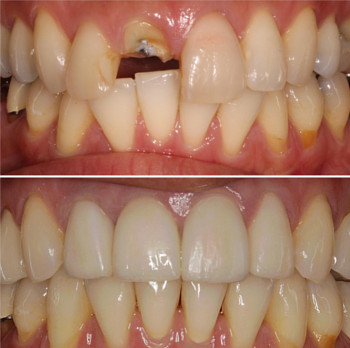
Union Square Dental Practice provides dental implants in downtown San Francisco for patients who need to replace missing teeth and restore chewing function, comfort, and smile confidence.
The office is located at:
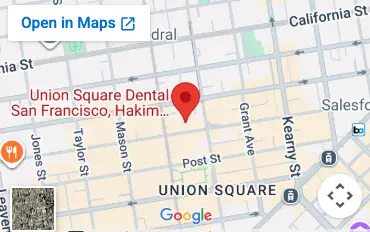
450 Sutter St #2414
San Francisco, CA 94108
Office hours:
Monday: 8 am – 5 pm
Tuesday: 8 am – 5 pm
Wednesday: 8 am – 5 pm
Thursday: 8 am – 5 pm
Friday–Sunday: Closed
Our Dental Practice is Located in the Financial District of Downtown San Francisco
For more information about our Dental Implants in San Francisco, or to schedule an appointment, please call our office at (415) 693-9139 or send an email to: info@unionsquaredental.com.