By Dr. Mahsa Hakim and Dr. Nazanin Hakim, Union Square Dental Practice, San Francisco
Key Takeaways
- Full dentures replace all teeth in one arch and rely on ridge anatomy, tissue support, border extension, and occlusal control.
- Partial dentures replace selected missing teeth while using the remaining teeth and oral tissues for support, with proper design helping minimize torque and instability..
- Immediate dentures preserve appearance after extractions, while implant-supported dentures use implants to improve retention, stability, and chewing confidence.
Dentures are not simply removable replacement teeth. In our work as dentists at Union Square Dental Practice in San Francisco, we approach them as carefully engineered prosthetic restorations. A denture must restore chewing, speech, facial support, esthetics, and confidence while respecting the biology of the mouth. The best design depends on bone shape, soft tissue health, bite forces, saliva, remaining teeth, and patient expectations.
There are several denture options, each addressing a different clinical problem. Full dentures replace an entire arch, partial dentures replace selected missing teeth, immediate dentures maintain appearance after extractions, and implant-supported dentures improve retention and stability. Choosing correctly requires diagnosis, planning, and long-term maintenance.
Understanding Dentures as Precision Prosthetic Dentistry
Dentures Are More Than “Replacement Teeth”
From a clinical perspective, we view dentures as biologic and mechanical prostheses, not simply artificial teeth set in acrylic. A well-designed denture must restore function, speech, facial support, vertical dimension, esthetics, and patient confidence. It also has to respect the limitations of the remaining oral anatomy. The success of a denture depends on ridge form, soft tissue resilience, muscle activity, saliva quality, and occlusal relationships. Two dentures may look similar outside the mouth but perform very differently once placed intraorally. That difference usually comes from fit, border extension, tooth position, and occlusal design.
Diagnosis Comes Before Design
Before recommending any denture type, we evaluate periodontal status, caries risk, bone volume, tissue health, opposing dentition, and parafunctional habits. For a fully edentulous patient, we assess whether the denture-bearing tissues can provide comfort and stability. For a partially edentulous patient, we determine whether the remaining teeth can predictably support a removable prosthesis. If implants are being considered, we evaluate bone height, bone width, anatomy, hygiene ability, and prosthetic space. The correct diagnosis determines whether the patient is better suited for a full, partial, immediate, or implant-supported denture. In our opinion, predictable denture treatment begins with diagnosis rather than a quick impression.
Matching the Prosthesis to the Patient
The right denture must match the patient’s anatomy, health, finances, dexterity, esthetic demands, and maintenance capacity. A conventional full denture may be appropriate for one patient but unstable for another with severe mandibular ridge resorption. A partial denture can be conservative when the remaining teeth are strong, but risky when abutment teeth are periodontally compromised. An immediate denture helps preserve appearance during healing, but it is usually part of a staged plan. Implant-supported dentures can greatly improve retention, but they require surgical planning and long-term hygiene. Our goal is to recommend the most stable and maintainable option for each individual patient.
Full Dentures: Complete Arch Rehabilitation
What Full Dentures Replace
A full denture, also called a complete denture, replaces all teeth in the upper arch, lower arch, or both arches. In the maxilla, retention usually comes from a peripheral seal, palatal coverage, and intimate tissue adaptation. In the mandible, retention is more difficult because the tongue, cheeks, and floor of the mouth constantly move around the prosthesis. The denture base must distribute force across the broadest tolerable area. It must also avoid excessive pressure on fragile, mobile, or ulcer-prone tissues. A full denture is therefore a tissue-supported prosthesis that depends heavily on impression quality and occlusal control.
Upper Versus Lower Full Dentures
Upper full dentures are often more retentive than lower full dentures because the palate provides a larger surface area. Lower dentures are more challenging because the mandibular ridge often resorbs significantly over time. The tongue also competes with the lower denture during speech and chewing. A patient may tolerate an upper denture well but struggle with a lower one. This does not always mean the denture was made poorly. Sometimes it reflects the natural biomechanical limitations of the lower arch. When conventional lower denture retention remains inadequate, implants may provide a meaningful improvement.
Occlusion and Vertical Dimension in Full Dentures
One of the most technical parts of full denture treatment is establishing vertical dimension and centric relation. If the vertical dimension is too high, patients may develop soreness, clicking teeth, muscle fatigue, or a strained facial appearance. If it is too low, the face may appear collapsed, and chewing efficiency may decline. We evaluate phonetics, lip support, freeway space, esthetics, and comfort when determining these relationships. The occlusal scheme must also reduce tipping forces during function. A successful complete denture allows the jaws to close predictably while distributing force across the supporting tissues.
Partial Dentures: Replacing Some Teeth While Preserving Others
The Biomechanics of Partial Dentures
A partial denture replaces one or more missing teeth while preserving selected natural teeth. Unlike a full denture, it must integrate with teeth that may differ in mobility, crown shape, periodontal support, and restorations. In design, we consider rests, guide planes, clasps, major connectors, minor connectors, and the path of insertion. The goal is not simply to fill visible gaps. The goal is to control prosthetic movement under chewing forces. A poorly designed partial denture can torque abutment teeth, trap plaque, and accelerate periodontal breakdown.
Tooth-Supported Versus Tissue-Supported Areas
The prognosis of a partial denture depends heavily on the missing-tooth pattern. Bounded spaces, where teeth remain on both sides of the gap, are usually more favorable. Distal-extension cases are more complex because the denture is supported by both teeth and compressible soft tissue. These structures move differently under load, creating rotational forces. We manage this with broad bases, functional impressions, indirect retention, and carefully positioned rests. In our practice, distal-extension cases receive special attention because they often appear simple but are mechanically complex.
Materials Used in Partial Dentures
Partial dentures may be made from cast metal frameworks, acrylic resin, flexible thermoplastics, or combined materials. Cast metal frameworks are often rigid, hygienic, durable, and favorable for long-term force distribution. Acrylic partial dentures may be useful as transitional or lower-cost prostheses, but they are typically bulkier. Flexible partials can improve clasp esthetics in selected cases. However, they may not provide the rigidity, adjustability, or repairability needed in more demanding situations. We choose materials based on periodontal health, esthetics, occlusion, hygiene ability, and expected service life.
Immediate Dentures: Teeth on the Day of Extraction
Why Immediate Dentures Are Used
Immediate dentures are inserted on the same day that teeth are extracted. They allow patients to avoid a period of being completely without teeth. This can be especially valuable when front teeth are involved. Immediate dentures also help support the lips and cheeks during early healing. Clinically, they can serve as protective prosthetic dressings over extraction sites. However, they are made before the final ridge shape is known. For that reason, we present them as part of a phased treatment plan.
Healing and Relines After Immediate Dentures
After extractions, the bone and soft tissues remodel continuously. The most noticeable changes usually occur during the first several months. As swelling decreases and the extraction sites heal, the immediate denture often becomes looser. This is a normal biological process, not necessarily a denture failure. We may use tissue conditioners, soft liners, adjustments, and later hard relines to improve adaptation. Follow-up visits are essential because sore spots and occlusal changes can develop quickly. The delivery appointment is only the beginning of immediate denture treatment.
Immediate Denture Limitations
Immediate dentures have important limitations. Because the denture is made before the extraction sites heal, the fit is partly predictive. Esthetics can be planned carefully, but refinements may be needed after tissue remodeling. The prosthesis may also require several adjustments and a future reline or remake. Some patients initially find immediate dentures bulky or unstable. They are also adapting to a new prosthesis while recovering from surgery. Patient satisfaction is highest when immediate dentures are understood as a controlled transition rather than a shortcut to the final result.
Implant-Supported Dentures: Improving Retention and Stability
How Implants Change Denture Mechanics
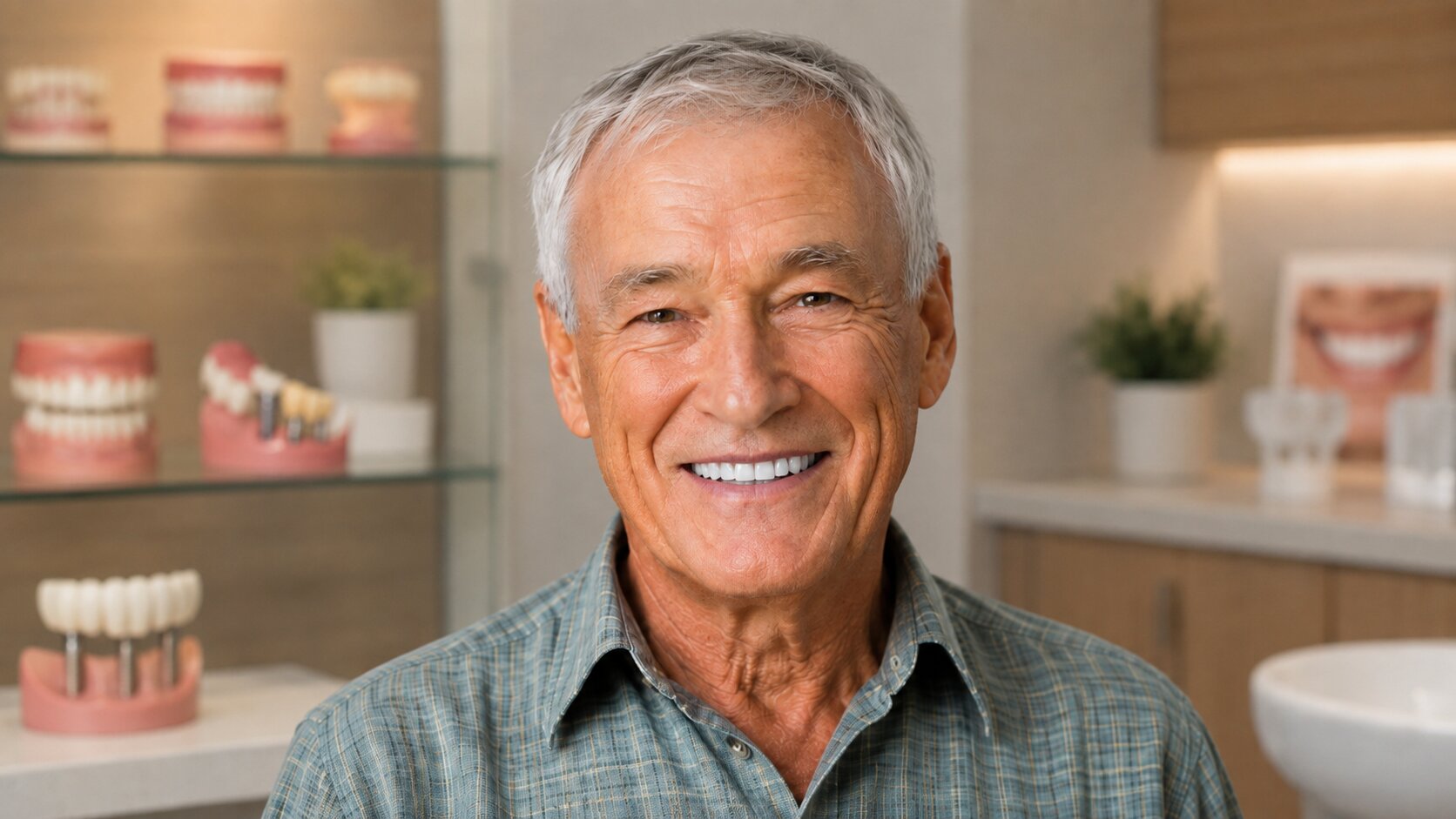
Implant-supported dentures use dental implants to improve retention, support, stability, or a combination of these qualities. From a biomechanical standpoint, implants reduce reliance on suction, soft-tissue compression, and muscular control. This is especially helpful in the lower arch, where conventional dentures often move more easily. Implant retention can improve confidence during chewing, speaking, laughing, and social interaction. The denture is less likely to lift or slide during function. For many edentulous patients, implant-supported dentures shift treatment from tolerating movement to engineering stability.
Removable Overdentures
A removable implant overdenture attaches to implants but can be removed by the patient for cleaning. It may connect through locator attachments, bars, clips, magnets, or other retentive systems. This option improves retention while still allowing access for hygiene. It can be ideal for patients who want more stability but do not want a fixed full-arch restoration. The number and position of implants influence retention, movement, and maintenance needs. Attachment inserts may wear over time and require replacement. We explain this as normal prosthetic maintenance, not as a complication.
Fixed Implant Dentures
A fixed implant denture is attached to implants and is not removed by the patient at home. These prostheses may use acrylic over metal, milled titanium, zirconia, or hybrid materials. Fixed implant dentures can provide excellent chewing confidence and stability. However, they are not maintenance-free. Patients must clean under the prosthesis with appropriate aids. We also monitor peri-implant tissues, prosthetic screws, occlusion, material wear, and hygiene access. We consider fixed implant dentures highly effective when the surgical, restorative, and maintenance requirements are fully understood.
Comparing Full, Partial, Immediate, and Implant-Supported Dentures
Functional Differences
The main functional differences between denture types depend on support and retention. A conventional full denture is primarily tissue-supported. It depends on extension, adaptation, seal, and occlusal control. A partial denture may be tooth-supported, tissue-supported, or both. An immediate denture is defined by its timing, as it is placed after extractions on the same day. An implant-supported denture gains retention or support from implants. In general, the more stable the foundation, the more predictable the function.
Esthetic Differences
Denture esthetics involve tooth shape, shade, gingival contour, midline, smile line, lip support, and facial balance. A full denture gives us broad control over tooth position and facial support. A partial denture must blend with remaining natural teeth, which may have wear, recession, discoloration, or restorations. Immediate dentures require careful pre-extraction planning using photographs, scans, models, and patient preferences. Implant-supported dentures can provide excellent esthetics, but the position of the implants and the visibility of the transition line must be evaluated. We design denture esthetics for the entire face, not just tooth color.
Maintenance Differences
Every denture type requires maintenance. Full dentures require evaluation for fit, occlusal function, tissue health, tooth wear, and fracture risk. Partial dentures require those same checks, plus monitoring of abutment teeth, clasps, rests, and plaque accumulation. Immediate dentures need short-term adjustments and relines as tissues heal. Implant-supported dentures require assessment of attachments, screws, peri-implant tissues, hygiene, and occlusion. Maintenance is not optional because oral anatomy changes over time. A denture that fits well today may need modification as the mouth remodels.
Clinical Planning: Anatomy, Bone, Soft Tissue, and Occlusion
Ridge Form and Denture Prognosis
Residual ridge shape strongly influences the performance of conventional dentures. Broad, firm ridges provide better support than narrow, sharp, mobile, or severely resorbed ridges. In the upper arch, palatal form and tuberosity anatomy affect retention. In the lower arch, ridge height, muscle attachments, retromolar pads, and floor-of-mouth movement are critical. We also evaluate undercuts, tori, flabby tissue, and ulcer-prone mucosa. In some cases, surgical modification may improve the prosthetic foundation. Denture planning is more predictable when anatomy is treated as a design factor.
Soft Tissue Health
Healthy soft tissue is essential for denture comfort. A removable prosthesis transmits functional load through the mucosa. Inflamed, infected, hyperplastic, or traumatized tissue cannot provide a stable foundation. Before final impressions, we may recommend tissue rest, denture adjustment, hygiene improvement, or treatment of lesions. Patients with dry mouth, smoking habits, or poor appliance hygiene may be more prone to inflammation. Sleeping in dentures can also increase tissue irritation for some patients. In our practice, tissue management is a core part of denture success.
Occlusal Load and Parafunction
Occlusal load must be carefully evaluated because dentures do not tolerate forces as well as natural teeth. Natural teeth have periodontal ligaments, while dentures transmit force through acrylic, attachments, implants, or soft tissue. Patients who clench or grind may experience soreness, fracture, tooth wear, or loosened prosthetic components. In full dentures, the occlusal design should reduce tipping forces. In implant-supported prostheses, occlusion must protect implants, screws, frameworks, and opposing teeth. We view occlusion as a long-term risk-control system. It should never be treated as only a final adjustment.
Materials and Digital Denture Workflows
Acrylic, Teeth, and Frameworks
Most traditional dentures use acrylic resin bases with acrylic or composite denture teeth. The base must resist fracture while remaining comfortable and easy to clean. Denture teeth must be selected for esthetics, wear resistance, occlusal compatibility, and available space. Partial denture frameworks may use cast metal, acrylic, or flexible materials, or combinations of these. Implant dentures may incorporate titanium, zirconia, reinforced acrylic, or hybrid designs. Material selection should consider force distribution, hygiene, esthetics, repairability, and opposing dentition. The best material is the one that fits the patient’s clinical situation.
Digital Impressions and CAD/CAM Dentures
Digital denture workflows have expanded how we capture, design, mill, print, and reproduce prostheses. In selected cases, scanning and CAD design can improve efficiency and reproducibility. Digitally archived designs can also make replacement or duplication easier. Milled denture bases may offer favorable adaptation due to reduced processing distortion. However, not every case is automatically better because it is digital. Mobile tissues, saliva, limited opening, and soft tissue compression can complicate digital capture. We use digital tools when they improve the clinical result, not as a substitute for judgment.
Try-Ins and Verification
Try-in appointments remain important in both conventional and digital workflows. During a try-in, we evaluate tooth position, smile line, lip support, phonetics, vertical dimension, and centric relation. For partial dentures, we verify framework seating, rests, guide planes, clasps, and tissue adaptation. For implant dentures, verification may include implant impressions, radiographs, jigs, torque protocols, and passive fit assessment. Skipping verification can create a denture that looks acceptable on a model but fails in the mouth. We prefer to verify fit, function, and esthetics in layers. Each layer reduces the risk of clinical compromise.
Adjustment, Adaptation, and Long-Term Maintenance
The Adaptation Period
Even a well-made denture requires adaptation. The cheeks, lips, tongue, muscles, and brain must learn to coordinate around the prosthesis. Patients may initially notice increased saliva, altered speech, soreness, or limitations in chewing. Adaptation is normal, but ongoing pain is not something patients should simply tolerate. Pressure spots can be adjusted, and occlusion can be refined. Borders can also be relieved if they are overextended. The goal is guided refinement, not passive endurance.
Relines, Rebases, and Remakes
Dentures do not fit perfectly forever because bone and soft tissues change. A reline resurfaces the tissue side of the denture to improve adaptation. A rebase replaces most or all of the denture base while keeping the existing tooth arrangement when appropriate. A remake may be needed when wear, poor fit, esthetics changes, fracture, or repeated repairs make modification insufficient. Loss of support, instability, and occlusal changes should not be ignored. A chronically unstable denture can traumatize tissues and reduce confidence. We prefer early intervention to prevent small problems from becoming larger prosthetic failures.
Implant Maintenance
Implant-supported dentures require structured maintenance. We monitor peri-implant tissues, plaque control, bleeding, occlusion, attachment wear, screw stability, and material wear. Removable overdentures may need replacement inserts, attachment cleaning, component tightening, or base adjustments. Fixed implant dentures require careful hygiene access because patients cannot remove them at home. Professional maintenance intervals depend on risk factors such as smoking, periodontal history, systemic health, dexterity, and hygiene ability. Implant prosthetics succeed long-term only when the prosthesis and tissues are monitored together. Maintenance is part of the treatment, not an afterthought.
Choosing the Right Denture Option
When a Full Denture May Be Best
A full denture may be appropriate when all teeth in an arch are missing or when remaining teeth have a poor prognosis. It can restore appearance and basic function without the need for implant surgery. This may be important for patients with medical, financial, or personal limitations. Full dentures can also restore lip support, facial contours, vertical dimension, and arch form. However, affordability does not mean simplicity. Complete dentures still require precise clinical and laboratory execution. When conventional retention is expected to be poor, we discuss implant-retained options early.
When a Partial or Immediate Denture May Be Best
A partial denture may be best when strategically located natural teeth can support and retain a removable prosthesis. It is often conservative because it replaces missing teeth without preparing every adjacent tooth for fixed bridgework. In some cases, a partial denture can be modified if additional teeth are lost. An immediate denture may be best when extractions are necessary, and the patient does not want to be without teeth. This is especially important when front teeth, speech, work, or emotional comfort are involved. Both options require careful design, adjustment, hygiene, and realistic expectations. Their success depends on planning as much as fabrication.
When Implant-Supported Dentures May Be Best
Implant-supported dentures may be best for patients who want greater retention, stability, chewing confidence, and improved quality of life. They are especially useful for unstable lower dentures, severe ridge resorption, and high functional demands. Implant overdentures can provide a practical balance between improved retention and removability. Fixed implant dentures can feel more stable but require more planning, cost, hygiene, and maintenance. We evaluate surgical candidacy, bone volume, bite forces, esthetic display, hygiene ability, and long-term service needs. The most advanced option is not always the best option. The best denture is the one that is stable, maintainable, safe, and appropriate for the patient.
Final Thoughts from Our Practice
Denture treatment deserves the same diagnostic discipline as advanced restorative dentistry. Full dentures, partial dentures, immediate dentures, and implant-supported dentures are not interchangeable products. They are different prosthetic strategies with different biological and mechanical demands. A successful denture must fit the tissues, support the face, harmonize with the bite, allow speech, and remain cleanable. Patients often focus on whether a denture will look natural. From a clinical standpoint, it is equally important that the denture functions predictably and protects the oral structures.
The most rewarding cases begin with careful diagnosis and honest expectations. A denture should be designed around the patient rather than forced into a generic category. Modern denture dentistry can provide excellent esthetics, comfort, and function when planned correctly. It also requires maintenance because oral tissues and prosthetic materials change over time. With the right design and follow-up care, dentures can restore more than missing teeth. They can restore confidence, facial support, chewing ability, and quality of life.

Denture Care at Union Square Dental Practice
At Union Square Dental Practice in downtown San Francisco, we approach denture treatment as part of a broader commitment to restorative, preventive, and cosmetic dentistry. Led by Dr. Mahsa Hakim and Dr. Nazanin Hakim, both UCSF School of Dentistry graduates, our practice has served the San Francisco community for more than two decades. When we evaluate a patient for dentures, we consider more than tooth replacement alone. We look at oral health, facial support, bite stability, esthetic goals, comfort, hygiene, and long-term maintenance. This allows us to recommend denture options that fit the patient’s anatomy, lifestyle, and expectations.
Our practice provides several services that may be relevant before, during, or after denture treatment, including dental implants, All On 4, dental crowns, fillings, nightguards, sedation dentistry, dental cleanings, veneers, Invisalign treatment, teeth whitening, and cosmetic dentistry procedures. For patients considering full, partial, immediate, or implant-supported dentures, we focus on clear education and careful planning so each person understands the benefits, limitations, and maintenance needs of their treatment. We also use modern dental technology and preventive care principles to help protect the remaining teeth, gums, implants, and oral tissues that support long-term denture success.
If you are missing teeth, have loose dentures, or are considering implant-supported options, we invite you to schedule a consultation with Union Square Dental Practice. During your visit, we can evaluate your oral health, discuss your goals, and explain which denture options may be appropriate for your specific situation. Our goal is to help you restore comfort, function, confidence, and a natural-looking smile with a thoughtful, practical, and personalized treatment plan.